
If you’re here then you already get a gold star from me ⭐️ because it means that you love your other half enough to try to understand what she’s going through. As you may know, you have had this blog thrusted at you because the lady in your life is of a certain age and suspects she might be going through the Perimenopause. This means that she’s not been feeling herself recently or has noticed a few things changing and might still be trying to get her head round it all. It’s not straightforward working out how and why you feel a certain way and working out whether the changes in your body are something to sit up and pay attention to or not. It might be that you are the one suggesting to her what might be going on. This is my hope anyway that there’s just more information out there and more conversations happening about the Perimenopause and particularly between couples.
Because of all the changes and the stage of life you’re both at, it’s not uncommon for communication and relationships to break down. I can only speak for myself here but I’ve had a lot of conversations with women since starting to write my blog and there are some common themes…. If you want to know how to reconnect with your missus, support her and rediscover that spark then read on.
First up, the not so pretty things to bear in mind
Periods
Periods there I’ve said it, it’s out there, what a pain they are anyway for women, every month for a week or so feeling like crap, your skin changes, you’re in pain due to cramps, you feel bloated, you can’t sleep or wear what you want, you have to know where the loos are, and have supplies with you and you might feel low or more angry than usual. Well during Perimenopause this gets worse for some. During Perimenopause, our key sex hormones start to decline, but this does not follow a linear pattern, instead it’s more like this…
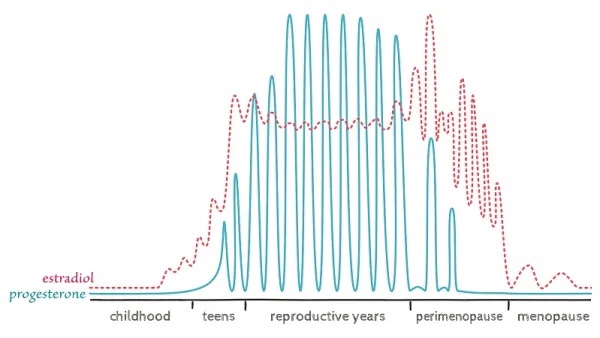
In other words a complete rollercoaster. It’s much more unpredictable than during your reproductive years and you don’t know when your period is going to happen and at times you feel like you’re permanently bleeding with no breaks. It’s draining. So genuinely if she says she’s not feeling like a roll in the hay, it’s not you okay? Don’t take it personally. Instead be lead by her. Let her decide when it feels right and works best, around how she’s feeling and where her cycle is at. More understanding and sympathy would go a lo-hong way.
Mood
Moods too can be very unpredictable. The relationship between mood and hormones is a complex one and there isn’t a direct causality between hormones being down and low mood for example, again it’s the fluctuations that link into mood shifts and changes. Plus all the other things she’s got going on, like whether she’s bleeding, whether she slept, whether she’s had a break recently and what else is going on. It can be a time when thoughts and feelings about the past come up and worries about the future set in. It’s a complex combo that even she can’t figure out but she’ll be trying. She might lie awake thinking about it all. The best thing you can do, is to proactively show you care, check in and ask what she needs, try to remain calm yourself and again see that it’s not about you (well it might be so you best check!) Frustration levels too can be due to emotions feeling more raw and just under the surface. Because our general emotional arousal is higher, small things can tip us into feeling overwhelmed, so if there’s too many people asking questions at the same time, too many things competing for our attention, too much noise or inanimate objects just refusing to do the thing they’re supposed to flipping do ha! You might spot this and be able to intervene. Send the kids out, take the inanimate object away, do the job, turn the telly off and pour her a nice cold glass of wine! Am I doing okay so far ladies?
Brain fog
Now would be a really good time to offer to sit down and delegate tasks amongst family members so that she doesn’t have to get to the end of her tether and ask you. If each person just takes one or two chores this will make a massive difference. You might be reading this and thinking well I already do this and that… that might be the case but you can do a little more. Compared to the eleventy million things she’s got on her to do list or worry list, I guarantee she’ll win every time. Recent research shows that women carry most of the mental load when it comes to organising the family. So it’s not just the doing it’s the worry, researching, and planning that goes into the actions. Generally decisions are made together but that’s after all the ground work is done by the woman. During Perimenopause cognition can be affected at times- her memory might suffer, attention, word finding, and clumsiness occurs which will embarrass her and frustrate her. Don’t draw attention to this (if you do well I warned you…) and reassure her that everyone makes mistakes (maybe you could remind her of one of yours to ease the shame). Cognition reconfigures after menopause but this takes time, so now more than ever you need to carry more of the load.
Mid life boredom
Perhaps, just maybe, she might be feeling that life’s getting a bit dull. Again don’t take this personally- it’s not you- instead it’s a time when women really start reevaluating themselves and their current circumstances. After the kids have grown and nearly flown or gone and she’s developed to where she wants to be with work, it’s common to ask questions about the meaning of life and everyone’s purpose and role. Maybe you are feeling this too? Well then what a perfect excuse to do something totally different. I know what you’re thinking 🤦♀️ and that’s okay- communicate, be honest and real with each other. I was also referring to how to spend your time though. Do you feel like you just work, eat, then plonk down together too shattered to even speak sometimes? This is where investing time is really important. Maybe plan to go out for the day, head out for a walk somewhere different, or book a gig to reminisce about your youth. What I’m saying crucially here is….you do it! You book it! You know her best. If you’re unsure then ask 🙃 then book something. Couples kayaking? Climb a mountain- no hire a tandem! Pack a picnic and away you go. In the short term, just suggest clearing an afternoon or an hour a week to just go for a walk together. Great things happen when people walk side by side. They talk. Generally this is what women need to feel close to you. To feel heard. To feel understood. Ask how she is and keep the phone at home. Really listen and ask relevant questions or simply say “I’m sorry sounds rough, I’m here for you”, you don’t have to fix it! She just needs to be heard and validated.
When tears come
When she seems teary, don’t panic! Your other half may or may not usually be emotional, but it’s very normal, at any life stage but particularly during Perimenopause. A hug might suffice. A break from the tasks might be nice. Have you considered asking “What do you need?” She might need space. You’ll not know if you don’t ask.
If you’re worried
If you’re concerned about her for example she’s isolating herself or shutting you out or drinking too much or anything concerning, gently check in with her. Say something like, “I noticed that you’ve not been yourself”…. You could offer to talk or suggest she sees a friend or goes to see her GP – you could offer to go with her or step aside. If she doesn’t give anything away perhaps ask a friend or family member to try checking in with her.
We care about how you are too
Lastly, if you’re struggling too or unhappy, let her know. She’ll be relieved that you’ve let her in, and been truthful. Honesty all the way, it’s the best policy you know! She’ll feel so much closer to you if she sees you being vulnerable- this is a strength, not a weakness. In any relationship it’s about compromising, give and take and recognising the links between how you are both coping and how that effects the other person. So this is not the blame game. For example if you are trying to cope with a hard day by zoning out and looking at your phone, she might perceive this as you shutting her out and she might cope with this by being a bit more arsey to let you know, which in turn will make you think she’s being unreasonable and you might snap at her making her feel more likely to pull away and the wedge between you gets bigger. It takes both parties seeing that what they’re doing isn’t intentional, it’s a way of surviving and managing their own stuff, yet recognising that these survival strategies do impact on the other person. So both need to make effort to see this and rectify it. No guilt, no shame, just reach out and say “sorry love” and try again.
You’ve come this far, you’ve helped each other and loved each other through thick and thin, so you can get through this too. Remember it’s not her fault. Women do get a raw deal in life, including when it comes to health, and there are still massive inequalities and injustices. You can help us out! She needs to feel that you’re on her side not against her. When you do this, when you value and cherish her, that’s when you’ll reconnect, maybe even more than before. That’s the amazing opportunity of Perimenopause. It’s not a stage to be feared, instead it’s a time of discovery, growth and renewal. Despite the challenges it presents, this, like any other life challenge, will make us stronger, and deepen our relationship with you too.
Photo by Maksim Goncharenok: https://www.pexels.com/photo/a-couple-walking-on-the-beach-5971184/
 Sea change