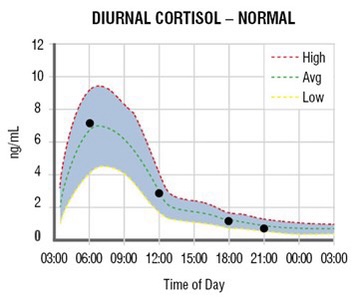
Do you wake up feeling anxious or nauseous? Not everyone realises that there is a biological reason for this, namely the cortisol awakening response, and it’s perfectly normal. The cortisol awakening response (CAR) is an increase in the stress hormone cortisol peaking 35-40 minutes after wakening. This occurs on top of the highest increase in cortisol that occurs during the second half of the night just before waking in the early morning. Following this, cortisol levels fall throughout the day.
The function of the CAR is not completely understood although one theory highlights the link to the hypothalamic pituitary adrenal axis which is regulated by the hippocampus. Whilst we know that the hippocampus is involved in memory consolidation, it is also involved in prospective memory (recalling the things we need to do) plus the hippocampus helps us develop a cohesive construct of the world around us, ie space, time and place. This latter theory makes sense when you think about sleeping somewhere new or somewhere dark and you wake up thinking where am I, what’s happening?! We also know that when a person is already experiencing stress in their daily life, the CAR is higher.
Whilst this is completely normal, because we have such tricky brains, if we perceive this increase in physical stress as threatening we might inadvertently further fuel the stress response or prolong it. Our thinking brain kicks in pretty much straight away and is so intrinsically linked with our animal brain that it’s really impossible to separate these two processes.
Therefore one of the first things that might help is to remind yourself that a racing heartbeat, nausea, shorter breaths or general feelings of anxiety first thing in the morning is likely to be nothing to worry about. As always – if this feels qualitatively different to you or more painful, it’s always worth discussing this with your doctor. You might be familiar with your body’s physical stress response, or you may not. The first time you notice or experience it, you might be concerned, but once you’ve established that it is normal, this can help to manage the experience. If you’re prone to worry, this is likely to exacerbate the stress response. Worry is the brain’s way of trying to problem solve, but when thoughts become cyclical and ruminative, it becomes more stressful and counterproductive. (Stay tuned for a future post on worry).
Panic is slightly different again to anxiety. Panic is anxiety about anxiety. The following principles can help, but it might be useful to see your GP or a therapist to help you break the cycle of panic. This is a fairly straightforward piece of work so don’t suffer in silence. (Again upcoming post on panic! So much to write about. I digress).
Coping with the cortisol awakening response:-
1. Take a minute to breathe and remind yourself that this is a normal, human experience and not a sign of illness.
2. Perhaps have a drink of water or herbal tea (you could try leaving your caffeine drink until slightly later in the morning) and use this as a short mindfulness exercise. To be mindful, try to bring your attention to the sight, smell, touch and taste. Watch the colour of tea swirl around as it releases from the tea bag. Notice the warmth from the mug in contact with your hands. Feel the steam as it rises to your face. How would you describe the taste? As you shift your focus to the present moment and really experience it, your body and brain can begin to calm down. Certainly, you’re not injecting more stress to feed the stress response. So even if you don’t feel massively positive, hopefully the process helps to cope in the moment.
3. Exercise in the morning can be beneficial on lots of levels. It provides a distraction, a boost of endorphins whilst improving your physical and mental health. Whether it’s yoga or a run or walk, or a swim, this can be a great start to your day. I recently started sea swimming with my daughter and we absolutely love it. The cold is invigorating and is a great way to gradually build tolerance to the fight or flight system in our bodies.
4. A healthy sleep routine starting the night before, can also help. This starts with prioritising sleep as it’s so important for health. I recently started a new skin care routine and I absolutely love that part of my day. Getting into my pjs (ah pjs are the best) removing my makeup if wearing it, using delicious smelling cleanser and refreshing spray toner and gorgeously rich night moisturiser- love it. Yes my other half wonders why I’m so long in the bathroom but I’m trying to keep this part of my routine going. It’s not something I used to prioritise at all. Plus all the usual stuff about getting a good night sleep like using your phone’s night mode, or avoiding devices in the last hour, avoiding caffeine, dimming the lights etc. A little tip if you’re a worrier or planner, prior to your calming hour of getting ready to sleep, write down all your worries or to dos so they’re out of your head. More on this to come…
 Sea change